





Ultrasonic Plastic Welding: Process Factors Every Assembly Engineer Should Understand

Why Ultrasonic Welding Has Become an Assembly Standard
Ultrasonic welding has earned a firm place in plastic assembly because it joins parts quickly, cleanly and without consumables such as adhesives, screws or solvents. The process works by applying high frequency mechanical vibration to thermoplastic parts held together under pressure. At the joint interface, friction and molecular movement generate localized heat, melting the material in a controlled zone. When vibration stops and pressure is held briefly, the melt solidifies and the parts become a single, integrated assembly. Because heating is concentrated at the interface, the rest of the part remains relatively cool, preserving appearance and dimensional stability. Weld times are typically very short, which makes the method attractive for high volume production in automotive interiors, electronics housings, household appliances, medical disposables, packaging and textiles. It also produces minimal fumes compared with many thermal joining methods, contributing to a cleaner work environment. Yet the apparent simplicity of the process hides a set of interacting variables that determine whether welds are strong and consistent. Engineers who understand these variables can design better parts, choose suitable equipment and set up processes that hold quality over long production runs, rather than relying on repeated trial and error each time a new product is introduced.
Amplitude, Pressure and Time as the Core Variables
The quality of an ultrasonic weld depends mainly on the amplitude delivered by the welding horn, the pressure applied to the parts and the duration of the weld and hold phases. Amplitude is determined by the transducer, the booster and the horn design, and it controls how much vibrational energy reaches the joint. Pressure ensures intimate contact between the parts so that energy concentrates at the interface rather than dissipating. Weld time sets how long energy is applied, while hold time allows the molten material to solidify under pressure. These factors must be balanced. Excessive energy can cause overheating, flash, burn marks or deformation, while insufficient energy leads to weak bonds or incomplete melting. Too much pressure can damp vibration and reduce efficiency, whereas too little can allow parts to shift or lose contact. Many modern welding generators allow amplitude to be adjusted steplessly and maintain constant amplitude despite changes in load or supply voltage, which helps stabilize results. Some systems also offer welding by energy, time or distance, giving engineers more ways to control the process. Systematic experiments that vary a single factor at a time, combined with destructive testing of sample welds, are the most reliable way to find a robust process window.
Joint Design and Material Compatibility
No amount of process tuning can fully compensate for an unsuitable joint design. Successful ultrasonic welding starts at the part design stage, where engineers decide how energy will be concentrated at the interface. Energy directors, which are small raised features on a mating surface, focus vibration into a narrow area so that melting begins quickly and spreads in a controlled way. Shear joints, where melting occurs along overlapping vertical walls, are often preferred for crystalline materials and for applications requiring hermetic seals. The distance between the horn contact surface and the joint, known as the near field or far field arrangement, also affects how efficiently energy travels through the part. Material selection plays an equally important role. Amorphous thermoplastics generally weld more easily than semi crystalline ones, and combining different materials requires careful evaluation of melt compatibility. Fillers, glass fibers, moisture content and additives can all influence weld behavior. Parts should be molded consistently, since variations in wall thickness, warpage or residual stress can change how energy is absorbed. Involving welding specialists early in the design process helps avoid costly redesigns later, and it allows tooling and fixtures to be planned alongside the part itself.
Horns, Boosters and Fixtures
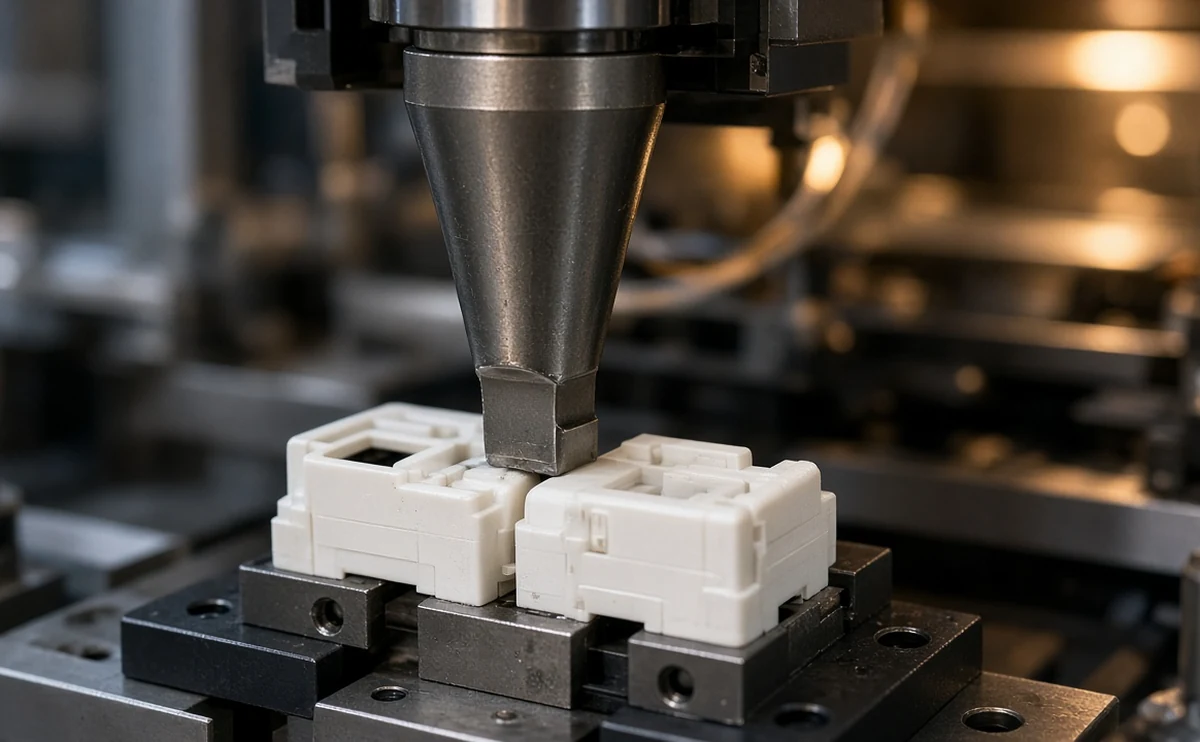
The mechanical components of a welding system are just as important as the generator. The transducer converts electrical energy into vibration, the booster adjusts amplitude, and the horn transfers that vibration to the part. Horns are carefully designed and tuned to resonate at the system’s operating frequency, and their shape must match the part’s contact surface while distributing amplitude evenly. Titanium and hardened steel are common horn materials, chosen for their acoustic properties and durability. A poorly tuned horn can cause uneven welds, excessive heat in the tooling or premature cracking. Fixtures, often called nests or anvils, support the lower part and must hold it firmly without damping vibration excessively or marking cosmetic surfaces. Alignment between horn and fixture is critical, since even small misalignments can produce inconsistent welds across a joint. Regular inspection of horns for wear, cracks or contamination, along with secure tightening of studs and interfaces between components, prevents many common problems. When products change, new horns and fixtures may be required, so it is wise to plan tooling lead times into project schedules. Working closely with tooling designers ensures that the entire acoustic stack and fixture system is optimized for the specific part geometry and production rate.
Handheld, Spot and Automated Applications
Ultrasonic welding is used in a wide range of formats, from compact handheld units to fully automated stations integrated into production lines. Handheld and spot welding tools are valued for flexibility, allowing operators to make localized welds, stake rivets or tack parts in situations where a fixed press would be impractical. They are common in garment and label processing, where fabrics, elastic bands and decorative elements are joined, as well as in automotive interior work, such as attaching insulation materials or securing small plastic fittings. Benchtop and press style welders provide precise control over force and stroke for repeatable assembly of housings, filters, toys and electronic enclosures. In automated lines, welding stations are integrated with conveyors, robots and inspection systems, and the generator communicates with the line controller to coordinate cycles and report faults. Each format brings different considerations for operator training, safety guarding and noise control. Handheld systems require attention to ergonomics and consistent technique, while automated systems depend on stable part supply and reliable fixturing. Choosing the right format begins with understanding production volume, part variety and the level of process documentation required, then matching equipment capabilities to those needs.
Quality Control and Continuous Improvement
Consistent ultrasonic welding requires ongoing attention to quality, not just a successful initial setup. Establishing clear acceptance criteria for weld strength, appearance and sealing performance gives operators and quality teams a shared reference. Destructive tests, such as pull or burst tests on sample assemblies, help confirm that the process window remains valid over time, while non destructive checks like visual inspection and leak testing can be applied to a larger share of production. Many welding generators record parameters for each cycle, including energy, time and distance, which can be monitored for drift that indicates tool wear, material variation or setup changes. Alarm functions and fault messages should be investigated promptly rather than simply reset. Preventive maintenance of transducers, boosters and horns, along with periodic verification of frequency and amplitude, keeps the system performing as intended. When problems arise, a structured approach that examines material batches, molding conditions, fixture condition and parameter settings usually reveals the root cause faster than random adjustments. Sharing lessons learned between design, molding and assembly teams builds a deeper understanding of how product and process interact. Over time, this continuous improvement mindset turns ultrasonic welding into a highly predictable and efficient joining method.
Safety, Noise and Operator Comfort
Ultrasonic welding equipment operates with high frequency vibration and significant clamping forces, so safety and operator comfort deserve careful attention. Press style welders should include guarding and safety interlocks that prevent hands from entering the welding area during a cycle. Handheld tools require clear training on correct holding, positioning and resting practices to reduce fatigue and avoid accidental contact with the horn. Some materials and joint designs produce audible noise during welding, and enclosures or acoustic panels can help keep workplace noise at comfortable levels. Cables and connectors should be routed to avoid tripping hazards and protected from damage. Regular checks of emergency stop functions, guarding and electrical connections form part of a responsible maintenance routine. When safety and comfort are designed into the workstation from the start, operators can focus on quality, and production runs more smoothly.