






How Ultrasonic Cleaning Is Reshaping Precision Parts Maintenance in Modern Industries

Why Precision Cleaning Has Become a Strategic Priority
Across machining, electronics, automotive service and medical device production, the cleanliness of a component is no longer treated as a minor finishing step. It has become a quality gate that directly affects coating adhesion, sealing performance, electrical reliability and the service life of assembled products. As tolerances tighten and part geometries grow more complex, traditional methods such as manual brushing, solvent wiping or simple spray washing struggle to reach blind holes, internal threads and narrow channels. Residual cutting oil, polishing paste, fine metal chips and dust that remain in these hidden areas can migrate later and cause failures that are expensive to trace. This is why engineering teams increasingly look at cleaning as part of process design rather than an afterthought. Ultrasonic cleaning fits this shift well because it works on the entire wetted surface of a part at the same time, including areas that cannot be seen or touched. Instead of depending on the skill and patience of an operator, the process relies on controlled energy in a liquid bath, which makes results easier to repeat from batch to batch. For manufacturers that ship parts to demanding customers, repeatability is often more valuable than raw speed, and it is a major reason the technology keeps spreading into new workshops.
How Cavitation Delivers Cleaning Power Without Abrasion
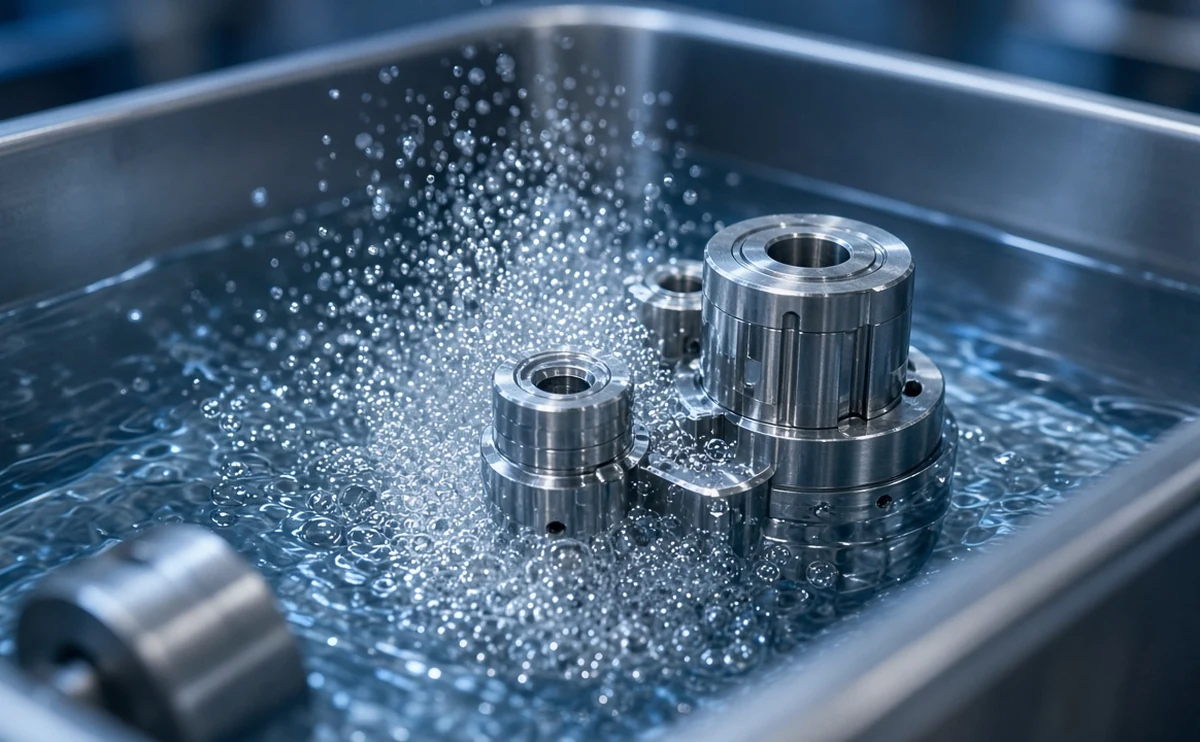
The core principle behind ultrasonic cleaning is cavitation. A generator converts mains electricity into a high frequency electrical signal, and transducers bonded to the tank or immersed in it turn that signal into mechanical vibration. The vibration travels through the cleaning liquid as alternating zones of compression and rarefaction. During the low pressure phase, countless microscopic bubbles form; during the high pressure phase, they collapse violently. Each collapse releases a tiny but intense burst of energy right at the surface of the part, loosening contaminants and lifting them into the solution. Because these events happen everywhere the liquid touches, the cleaning action follows the contour of the workpiece instead of acting only where a brush or nozzle is pointed. Importantly, the process does not rely on abrasive contact, so delicate finishes, fine edges and soft metals can be cleaned without scratching when parameters are chosen correctly. The chemistry of the bath still matters, since detergents help dissolve oils and keep removed particles suspended, and temperature influences both chemical activity and bubble behavior. When frequency, power, chemistry and time are balanced, cavitation provides a gentle yet thorough method that can replace aggressive solvents in many applications and reduce the physical effort required from workers.
Industries Driving Wider Adoption
Automotive repair shops and component remanufacturers were among the early adopters, using ultrasonic tanks to clean carburetors, fuel injectors, filters and engine parts that are packed with internal passages. Precision machining companies followed, using the method to remove coolant and chips before inspection or assembly. In electronics, ultrasonic cleaning helps remove flux residue and handling contamination from boards and connectors, although engineers must pay close attention to frequency selection and component sensitivity. Optical workshops rely on it to prepare lenses and glass parts for coating, while jewelry and watch makers use it to restore shine to intricate pieces. Medical and laboratory environments clean instruments, glassware and tools before sterilization, benefiting from consistent coverage of hinged and serrated surfaces. Mold makers and injection molding plants use ultrasonic and electrolytic combinations to remove gas residue and release agents from cavities without damaging polished faces. Even food service equipment, filters and spinnerets for fiber production are cleaned this way. Each sector brings its own contaminants and quality expectations, which pushes equipment builders to offer a wide range of tank sizes, frequencies, heating options and filtration features. This diversity of demand is a healthy sign that the technology has matured from a niche tool into a broadly accepted industrial process.
Integrating Ultrasonic Systems Into Production Lines
As adoption grows, buyers are moving beyond standalone benchtop units toward integrated cleaning stations and multi stage lines. A typical line may combine a pre wash stage, an ultrasonic cleaning stage, several rinsing stages and a drying section, with baskets or conveyors moving parts between them. Immersible transducer packs give engineers flexibility to retrofit existing tanks or build custom vessels around unusual part shapes. Generators with adjustable power and frequency tracking help maintain stable performance as the liquid level, load and temperature change during a shift. Remote control interfaces allow cleaning equipment to communicate with a plant controller, so that cycle start, stop and alarms can be coordinated with upstream machining or downstream assembly. Filtration and oil separation systems extend bath life and keep cleaning quality consistent, while heating elements maintain the temperature that the chosen detergent needs. When planning integration, it is wise to map the part flow, cycle time and space available before choosing equipment, rather than buying a tank and then designing the process around it. Thoughtful integration turns cleaning from a bottleneck into a predictable, documented step that supports overall throughput and traceability.
Environmental and Workplace Benefits
Many companies first explore ultrasonic cleaning because they want to reduce their dependence on harsh solvents. Water based detergents combined with cavitation can often achieve comparable or better results than vapor degreasing or solvent soaking, while lowering emissions, odor and fire risk in the workshop. Reduced solvent use also simplifies storage, handling and disposal, which can ease compliance work for environmental and safety teams. Workers benefit when manual scrubbing is replaced by loading baskets and starting a timed cycle, because repetitive strain and skin contact with chemicals are reduced. Cleaning quality becomes less dependent on individual technique, which helps when staff change or when production expands to additional shifts. Energy efficiency is another consideration, since well matched generators and transducers convert electrical energy into useful acoustic energy with limited waste, and heating can be managed with insulation and lids. Of course, ultrasonic systems are not entirely free of environmental impact; spent cleaning solution must still be treated or disposed of responsibly, and noise should be controlled with covers or enclosures. Yet when the full picture of chemicals, labor and rework is considered, many facilities find the method supports both sustainability goals and a more comfortable working environment.
What to Expect as the Technology Continues to Evolve
Looking ahead, the direction of ultrasonic cleaning is shaped less by dramatic breakthroughs and more by steady refinement. Equipment builders continue to improve transducer bonding, generator stability and tank construction so that systems run reliably for long periods with minimal adjustment. Multi frequency designs give users the option to switch between stronger, coarser cleaning and finer, gentler action within the same tank, which is helpful for shops that handle very different parts. Better control interfaces make it easier to store recipes for specific parts and to document each cycle, supporting quality audits. There is also growing interest in combining ultrasonic energy with other processes, such as electrolytic cleaning for molds or sonochemical processing for liquids, which broadens what a single investment can achieve. For buyers, the practical takeaway is that choosing ultrasonic equipment should start with a clear understanding of the contaminants, materials, part sizes and quality targets involved. Trials with real parts, honest discussions with suppliers and attention to maintenance planning lead to better outcomes than focusing on headline specifications alone. When approached this way, ultrasonic cleaning becomes a durable part of the production toolkit rather than a short lived experiment.
Building Internal Knowledge Around the Process
Companies that gain the most from ultrasonic cleaning usually invest in understanding the process rather than treating the tank as a black box. Keeping simple records of which parts were cleaned, which settings were used and what results were achieved creates a practical knowledge base over time. When a new part family arrives, engineers can refer to similar cases instead of starting from scratch. Sharing these observations between production, quality and maintenance teams also helps everyone recognize early signs of change, such as weaker cavitation or residues returning on familiar parts. Short training sessions on how frequency, temperature, chemistry and loading interact give operators the confidence to report problems accurately. This internal knowledge complements support from equipment suppliers and turns ultrasonic cleaning into a dependable capability that grows with the business.